
A friend recently sent me this image via WhatsApp. As there was no comment attached, I was left guessing about his reasons for sending it.
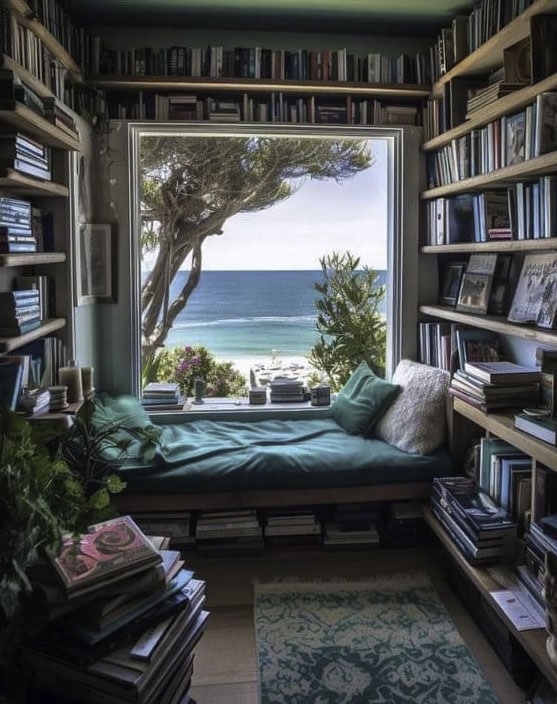
click on image for further detail
My immediate reaction was something along the lines:
“Wow – gorgeous. Another photo from someone’s dream holiday.”
Closely followed by feelings of envy, mixed with a degree of mild irritation directed at people who feel compelled to let you know just what a fantastic life they are having.
But then, as I looked more carefully, I saw that this was a generated image – not a painting, a photograph or anything else made by a real person, but an image produced by one of the latest (so-called) artificial intelligences and employing a process comparable to lowering a bucket into a vast well of collective, digitally-coded imagery and bringing it back up, brimming with treasure.
Such generators, in their current (2023) state of development, exhibit a number of eccentricities that make it easy to distinguish the images they produce from the original paintings, drawings and photographs used to ‘train’ them.
Looking at this example, there are quite a few of these giveaways:
Some of the books don’t look quite right. Those on the lower, right-hand shelf have a very unusual, tall and narrow proportion and, though the image resolution is not sufficient to show details of the covers or spines, there is absolutely nothing there that is recognisable. This appears to be typical of image generators. They can produce a convincing view of a room but if there are pictures on the walls then the pictures themselves are frequently only half-formed – like the early stages in the development of an embryo.
This tendency is most clearly demonstrated, in this picture, by the pattern on the rug which, while superficially, convincing, is unlike anything seen on a real rug.1No doubt this might change, as rug manufacturers turn to image generators for their designs. Also the pattern of light and shade on the rug is the reverse of what you might expect.
And the framed picture in the left hand corner of the room is really strange. It has been folded into a right-angle in order to fit. It is probably the clearest indicator that this image was automatically created.
You might think that my point in drawing attention to these mistakes is to belittle the capabilities of image generators, to scoff at their blunders, but this is not my intention at all. On the contrary, the mistakes supply the clearest evidence that this image has not been merely retrieved but has been constructed from scratch, from the raw, protean stuff distilled from a vast training set.
And while we may mock the mistakes, what is truly remarkable is that the picture, taken as a whole, is capable of appealing to some of our deepest emotions. When I first saw this picture, I imagined myself staying alone for a time at this house by the sea, where I would spend much of my time preparing simple food, reading and enjoying evening walks along the shore. And there’s the tree that not only protects the window from glare but hints at a shady spot, just outside, where – most likely – there is an old, salt-bleached table and chair. And the day-bed, clearly only recently vacated, with its green coverlet echoing the colour of the sea, the colour of shallow, sunlit water over sand or the part of the sky that touches the horizon, at the end of a perfect summer day.
And yet, despite these associations, the image was not made specifically to appeal to me, neither did it emerge from the imagination of an individual artist. Rather it was was forged within the depths of an arcane repository in which the collective visual wealth of an entire culture,2 Albeit, a culture that is largely confined to western, industrial countries is mathematically encoded. All the same, the fact that the same image has the ability to resonate emotionally with our human imaginations should come as no surprise, given that our imaginations are formed from exactly the same stuff.
As such images become more common, they may help define a novel artistic medium, initially tentative and ill-defined, but later, on account of the sheer volume of output, capable of claiming a place alongside well-established media like painting and photography.
Or maybe we will use our ability to recognise generated images solely in order to dismiss them as worthless – like connoisseurs of art disputing the authenticity of a Rembrandt
- 1No doubt this might change, as rug manufacturers turn to image generators for their designs.
- 2Albeit, a culture that is largely confined to western, industrial countries
Perhaps another take is to see this as AI ‘art’ imitating Life?
Take Instagram. I am a light user, but my limited experience is that one simply glances at the images presented, reacts, and perhaps responds with a quick comment or simply an emoji. However, my reading informs me that the images presented are as likely as not to have been cropped, edited or photoshopped before loading. So, in some ways as fake (or at least unrealistic) as the AI image presented.
On a broader level, many do not fully appreciate the essential premise of AI is that it is dynamic. The core programming concepts being developed are for computers to ‘learn’. In other words they programme themselves to get better at achieving tasks.
These tasks will/have become more complex, and AI capabilities are developing fast. Soon, perhaps already, AI driven machines will be making balanced judgements on big calls – more quickly and accurately than any human can make them.
In fact, this is already happening. Many examples to date are benign. For instance, the recent development of AI to process cancer scans faster and more accurately than any human ever can.
Similarly, AI is already being fitted installed many electric cars. In some circumstances, it is now possible for the computer to park or even drive the vehicle. As the AI ‘learns’ to drive more effectively and becomes more widespread, it is conceivable that human drivers will be replaced, and human error will disappear. If that reduces or even ends road traffic deaths (over 1,700 in 2022) very few will argue.
This is the direction of travel. And it is accelerating, fast.
The challenge is that humans set the direction of travel and decide the parameters for AI (or Machine Learning). The very real and present nightmare scenario is illustrated in the Book and then film The Boys From Brazil. In that tale, 95 clones of Hitler are spawned, With AI, the potential evil generated could be more pervasive and powerful than 95 madmen.
All this seems a long way from an AI generated photograph. But the photograph is instructive: it is happening, and it is innocent enough. However, it is akin to the tip of an iceberg. So much more than we can see or know is being developed and there is no one who is setting the parameters for how far it will extend.
For a holiday dwelling the image looks a bit too book-ish for me. I might be daunted by the amount of reading material. The thing is – each of the ‘defects’ you’ve listed could be corrected. The machine could be told that pictures never go round a corner – or that there’s a limit to the proportions to which you can stretch a book. My sister has a carpet so worn out that its patterns look quite like the one in this picture. So what is it about this picture that’s so disturbing- if we hadn’t known that it was generated by a machine would we feel more connection to it?
I’d say yes. The machine that made it has never felt the wind on its face or felt daunted by too many books to read or wondered whether it needs sun cream if it’s going to go outside. It leads a limited isolated life – perhaps in a basement, gathering dust, receiving updates to its thinking processes over which it has no control. It may occasionally break down and have to be repaired whilst it consumes images for future reference in order to perfect its technique in emulating a human. And it doesn’t even know that that’s what it’s doing.
I think this whole AI thing is over hyped. Give me consciousness, despair, depression, elation or awareness of drudgery any day!
You’ve persuaded me a bit more that it is not a language guided 3D renderer, though not entirely.
But if it comes up with images by stealing other images from the internet….
The artists/photographers who images it steals are not compensated for their work. That is also true of human artists who steal to though I suppose.
(Don’t quote me about good artists stealing etc. etc.!)
But like Chat GPT without the data created by humans initially we can’t expect much *new* from these systems. They seem to be designed to satisfy expectations of the users.
Many AI and NN systems do come up with novelty and new solutions though, that is their power.